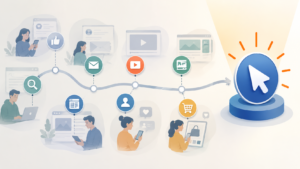
Every marketing campaign aims to capture attention, but true success depends on converting that early interest into actual business growth. While traditional models treat marketing and sales as separate functions, the modern customer journey is a continuous path flowing from initial brand awareness directly to final revenue.
Understanding this path requires moving beyond surface-level metrics like clicks and impressions to focus entirely on genuine commercial outcomes. By uniting fragmented data across marketing platforms, sales pipelines, and customer support systems, businesses can uncover the exact touchpoints that drive profitability, eliminate waste, and optimize every stage of the user experience.
What Is the Customer Journey?
A customer journey is the sequence of touchpoints a customer experiences before, during, and after a purchase. A touchpoint is any interaction between the customer and the business, including both company-controlled interactions and outside influences such as referrals, reviews, and social media conversations.
In practical terms, the customer journey answers questions like:
- Where did the customer first find us?
- Which channels influenced their decision?
- What happened between lead capture and purchase?
- Which campaign, call, CRM record, or POS transaction connects to revenue?
- Where are customers dropping off before they convert?
For Mackdata, this matters because the journey is not just a marketing concept. It is a data problem. If CRM, POS, call-tracking, ad platforms, and analytics tools are not connected, businesses see fragments instead of the full journey.
Unify your disconnected data silos to see the exact path your buyers take today
The Main Customer Journey Stages
Most customer journey models include pre-purchase, purchase, and post-purchase activity, often broken into more specific stages such as awareness, consideration, decision, retention, and advocacy.
1. Awareness
Awareness starts when a customer realizes they have a need or discovers your brand. This might happen through Google search, paid ads, social media, word of mouth, a direct mail campaign, or a local listing.
For a home services company, awareness might begin when a homeowner searches for an emergency plumber. For a retail brand, it may start with a paid social ad. For real estate investors, it may begin when a seller responds to a campaign.
2. Consideration
During consideration, the customer compares options. They may read reviews, visit service pages, request pricing, call the business, or return to the website several times.
This is where cross-channel marketing performance becomes important. A lead may click a paid ad first, return through organic search, then call from a landing page. If only the last click is tracked, the business misses the earlier influence that helped create the opportunity.
3. Decision or Conversion
The decision stage is defined by concrete, measurable action. This includes booked jobs, completed sales, signed deals, submitted forms, or revenue-generating phone calls.
This stage is also where standard analytics setups typically fail. Marketing platforms track upfront leads but miss the closed revenue. Conversely, CRMs track deals but fail to attribute them to the original ad or campaign. Mackdata’s marketing attribution software bridges this gap, connecting top-of-funnel actions directly to bottom-line revenue.
4. Retention and Advocacy
The customer journey extends far beyond the initial purchase because post-purchase experiences directly dictate long-term customer lifetime value. By mapping the exact user experience at every touchpoint, companies actively identify friction points to optimize their entire process.
For operators, retention data delivers clear insights by identifying returning customers alongside the specific campaigns and profitable segments that drive value over time.
Master every stage of your buyer pipeline to maximize conversions and accelerate business growth
Why the Customer Journey Matters for Revenue
A customer journey is useful only if it helps the business make better decisions. The goal is not to draw a pretty map. The goal is to understand which touchpoints lead to revenue, where money is being wasted, and what action should happen next.
A strong journey analysis helps teams:
- Identify the channels that create qualified leads.
- Connect marketing spend to booked jobs, closed deals, or completed sales.
- Find gaps between lead generation and actual revenue.
- Improve customer experience across sales, service, and follow-up.
- Forecast demand based on real historical behavior.
This is why AI marketing intelligence software like Mackdata matter. Static dashboards often tell teams what happened in separate systems. A connected intelligence layer can show how those systems work together.
Customer Journey vs. Marketing Funnel
The marketing funnel is a simplified model. It usually moves from awareness to interest, desire, and action. The customer journey is more detailed because it captures real behavior across multiple channels and moments.
The difference looks like this:
- Funnel: A prospect sees an ad, visits a page, converts.
- Journey: A prospect sees an ad, reads reviews, compares providers, calls twice, checks pricing, talks to a rep, books later, buys again, and refers someone else.
For most businesses, the second version is closer to reality. A home services marketing software strategy should not stop at lead count. It should show which campaigns became booked jobs. A real estate marketing software setup should connect seller leads to closed deals. A retail marketing software system should connect campaigns to visits, transactions, and sales.
The customer journey becomes more valuable when it moves from a diagram to a revenue signal.
How to Map the Customer Journey With Data
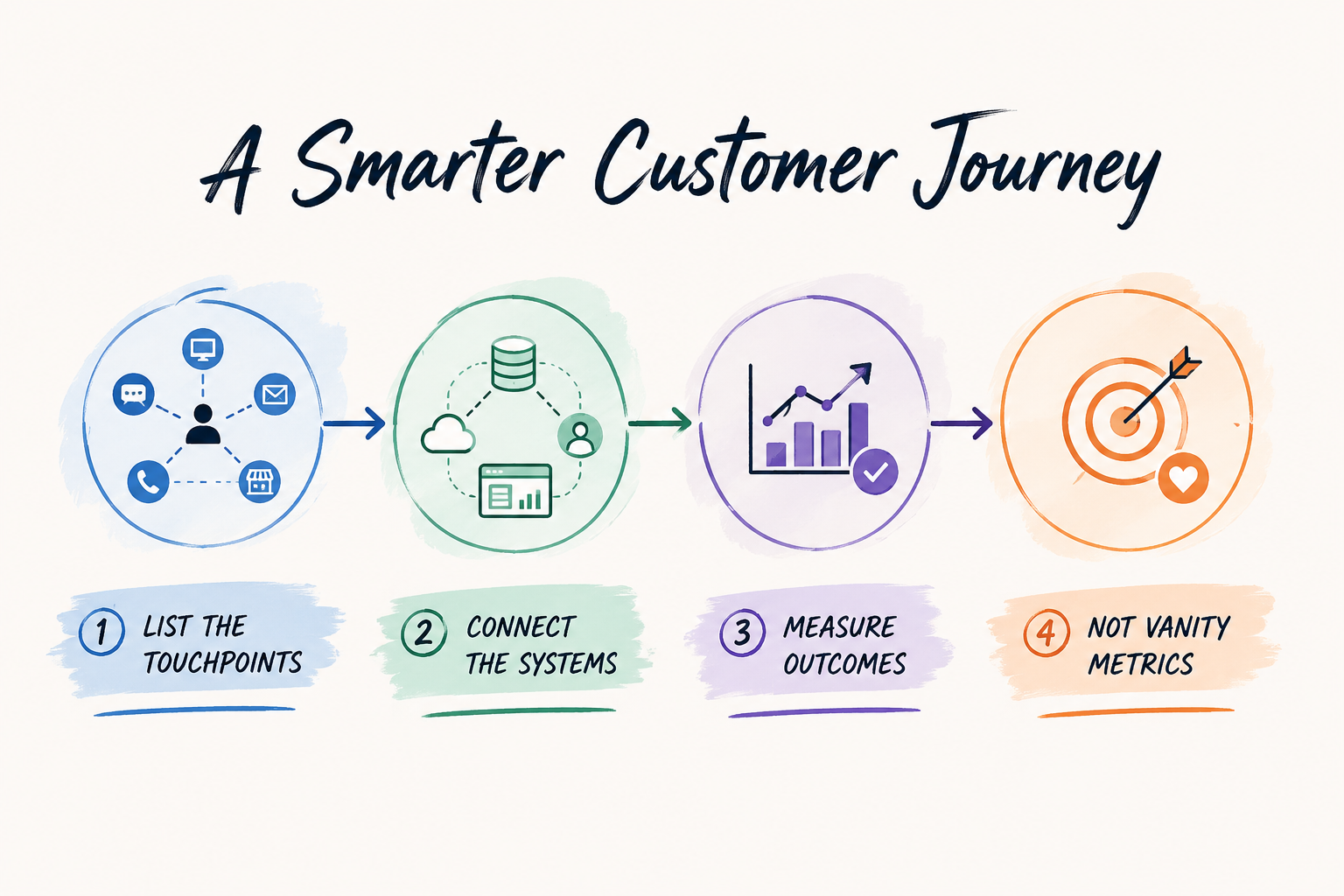
A customer journey map becomes stronger when it is built from actual business data, not assumptions. Start with the customer’s path, then connect the systems that prove what happened.
Step 1: List the Touchpoints
Document every place a customer might interact with your business:
- Paid search and paid social campaigns
- Organic search and website visits
- Phone calls and form submissions
- CRM records and sales notes
- POS transactions or closed deals
- Email, SMS, reviews, and referrals
Step 2: Connect the Systems
Next, connect the data sources behind those touchpoints. This might include Google Ads, Meta, call tracking, CRM, POS, website analytics, and offline sales records.
This is where many companies struggle. Each platform reports its own version of truth. Mackdata is built to sit on top of existing systems and unify those signals so teams can ask direct questions instead of manually reconciling reports.
Step 3: Measure Outcomes, Not Vanity Metrics
Clicks, impressions, and form fills matter, but they are not the final outcome. The real question is whether those interactions produced revenue.
A better customer journey report shows:
- Which channel created the first touch.
- Which touchpoints assisted the conversion.
- Which campaign drove the highest-value customer.
- Which source produced booked jobs, closed deals, or sales.
- Which journey patterns predict future revenue.
Mackdata helps businesses see the story behind each customer journey. By connecting fragmented data across marketing and sales systems, it shows whether early interest became real revenue and gives teams the clarity to invest in the moments that actually move customers forward.
Replace guesswork with concrete data by building customer maps directly from your live systems
Common Customer Journey Mistakes
The most common mistake is treating the journey as a marketing-only exercise. Sales, operations, customer service, and finance often hold critical pieces of the same story.
Other mistakes include:
- Giving all credit to the last click.
- Ignoring phone calls and offline conversions.
- Tracking leads without tracking revenue.
- Separating CRM data from marketing data.
- Looking at dashboards without asking what action should follow.
A disconnected journey creates bad budget decisions. A connected journey shows what is working, what is leaking, and where growth is hiding.
Turn the Customer Journey Into Better Decisions
Mackdata helps businesses turn disconnected customer journey data into clear revenue intelligence. By connecting marketing platforms, CRM, POS, call-tracking, and analytics systems, Mackdata shows how customer touchpoints become booked jobs, closed deals, and completed sales. Instead of relying on surface-level activity metrics, teams can see what actually drives growth.
Why Business Use Our AI Marketing Attribution Software
Connect Every Customer Touchpoint
Businesses choose Mackdata because we bring fragmented systems into one connected view. Marketing, sales, call, and transaction data work together, helping teams understand how customers move from first interaction to final revenue outcome without manually piecing reports together across platforms.
Tie Marketing Spend to Revenue
Mackdata helps businesses see whether campaigns create real commercial results. Instead of judging performance by clicks or form fills alone, teams can understand which touchpoints influence revenue, which channels deserve more budget, and which efforts are not producing meaningful business outcomes.
Ask Better Questions With AI
With Mack, Mackdata’s conversational AI assistant, teams can ask business questions in plain language and get direct answers from connected data. This helps operators move faster, avoid dashboard overload, and make confident decisions based on revenue, customer behavior, and performance trends.
If your customer journey is spread across CRM, POS, call tracking, and marketing platforms, Mackdata can help connect the path from first touch to revenue.
The best customer journey map does not just explain the past. It shows the next best move.
Frequently Asked Questions About the Customer Journey
Why is customer journey mapping important?
Customer journey mapping helps businesses identify friction, understand customer behavior, and improve marketing, sales, and service decisions. When paired with attribution data, it can also show which touchpoints contribute to revenue.
How does attribution improve customer journey analysis?
Attribution connects touchpoints to outcomes. Instead of seeing isolated clicks or leads, businesses can understand which campaigns, channels, and interactions helped produce booked jobs, closed deals, or completed sales.
What tools are needed to track the customer journey?
Most businesses need data from ad platforms, website analytics, CRM, call tracking, POS, and sales systems. Mackdata connects these sources so teams can analyze the full customer journey without relying on disconnected dashboards.