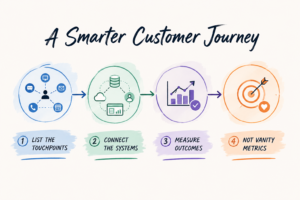
In an ecosystem where a single buyer engages with a brand dozens of times before converting, fragmented data is a major liability. Marketers often find themselves trapped in an “attribution tug-of-war” where every platform competes for credit, obscuring the true drivers of growth.
Implementing a robust attribution model cuts through this noise. It provides the granular visibility needed to distinguish between channels that merely “show up” and those that actually generate demand. By shifting from surface-level clicks to deep-funnel analysis, you ensure your ad spend is optimized for long-term efficiency rather than just short-term volume.
What Attribution Modeling Actually Tells You About Ad Spend
At its best, attribution modeling shows how touchpoints contribute across the full customer journey. Instead of looking only at clicks, leads, or isolated platform dashboards, marketers can evaluate how paid search, paid social, email, content, calls, and CRM outcomes work together.
That shift matters because targeted ad spend should be based on more than surface-level conversions. A channel that rarely gets the last click may still introduce high-value customers. Another channel may look efficient on paper while simply capturing demand created elsewhere. Attribution modeling helps separate those realities.
Why Last-Click Reporting Creates Expensive Blind Spots
Many teams still rely too heavily on last-click thinking. That means the final touchpoint before conversion gets all the credit, while earlier touchpoints are undervalued or ignored entirely. The result is predictable: upper-funnel campaigns look weak, branded search looks stronger than it really is, and remarketing appears more influential than it may be.
That reporting bias often leads to three costly mistakes:
- Cutting awareness spend too early
- Over-investing in bottom-funnel capture channels
- Missing the true channel combinations that drive profitable growth
For businesses trying to improve return on ad spend, those blind spots can turn media planning into guesswork.
See Your True Revenue Story With AI Marketing Attribution
Mackdata helps teams connect marketing touchpoints to real revenue outcomes so ad spend decisions reflect what actually drives growth, not just what platforms claim.
The Main Attribution Models Marketers Use
There is no universal attribution model that fits every business. The right choice depends on sales cycle length, data quality, channel mix, and the level of sophistication your team can support. Still, most marketers evaluate the same core models.
Last-Touch Attribution
Last-touch attribution gives full credit to the final interaction before conversion. It’s simple and widely used, but often overvalues bottom-funnel channels like branded search or retargeting, making it too limited for accurate budget decisions on its own.
Linear Attribution
Linear attribution distributes credit evenly across all touchpoints. It offers a balanced view and is useful for multi-touch journeys, but it assumes every interaction has equal impact, which can oversimplify how different channels actually influence conversions.
Time-Decay Attribution
Time-decay attribution gives more credit to touchpoints closer to conversion. It works well for short sales cycles but can undervalue early-stage marketing efforts, especially in longer journeys where awareness and consideration play a significant role.
Position-Based Attribution
Position-based attribution gives the most credit to the first and last touchpoints, with the rest shared across the middle. It balances awareness and conversion impact while still acknowledging supporting interactions, making it a practical middle-ground model.
Data-Driven Attribution
Data-driven attribution uses algorithmic analysis to assign credit based on actual observed patterns in your conversion paths. Rather than applying a fixed rule, it evaluates how touchpoints contribute across many journeys.
In theory, this is the most advanced option because it adjusts to the behavior in your own data. In practice, it also depends on strong tracking, enough conversion volume, and clean integration across systems. When those ingredients are missing, data-driven attribution can still produce misleading confidence.
Want Attribution That Goes Beyond Platform-Reported Conversions?
Mackdata helps marketers move beyond isolated channel dashboards by connecting attribution to customer journeys, business outcomes, and revenue visibility.
How To Choose The Right Attribution Model For Targeted Ad Spend
Match The Model To Your Sales Cycle And Customer Journey
If your business has a short path to purchase, a simpler model may be enough to start. If you have a longer, more complex customer journey with multiple touchpoints, multi-touch reporting becomes more important.
Ask questions like:
- How many interactions typically happen before conversion?
- Do awareness channels play a meaningful role early in the funnel?
- Are customers converting online, offline, or through a mix of both?
- Does your team need directional insight or highly precise modeling?
The more layered the journey, the less useful single-touch attribution becomes.
Align Attribution With Channel Mix And Business Goals
The right model should reflect the channels you actually use and the questions you need answered. If your ad spend is concentrated in bottom-funnel search, a different model may be sufficient for tactical optimization. If your budget spans paid social, search, email, content, calls, and offline sales activity, you need a broader attribution view.
It also helps to align the model with the outcome you care about most. Are you optimizing for leads, booked jobs, closed deals, in-store purchases, or customer lifetime value? Those are not interchangeable goals, and your attribution framework should reflect that.
Best Practices For Implementing Attribution Models
Centralize Ad, CRM, Call Tracking, And Revenue Data
The biggest leap in attribution maturity usually happens when teams stop reporting from disconnected systems. Ad platform data, analytics data, CRM records, call tracking, scheduling data, and revenue outcomes should be connected into one usable environment.
Without that connection, attribution remains partial. You may know which campaign generated a form fill, but not whether it became a customer. You may know which ad drove a call, but not whether that call turned into revenue. Centralized data closes those gaps.
Measure Outcomes That Matter Beyond Leads
Leads are not enough. Marketers need attribution tied to business outcomes that reflect real performance.
Depending on the business, those outcomes might include:
- Cost per booked job
- Cost per closed deal
- Revenue by marketing source
- Return on ad spend by channel
- Customer lifetime value by acquisition path
When teams optimize only for cheap leads, they often end up buying low-quality volume. Attribution becomes more strategic when it connects spend to outcomes the business actually values.
Compare Assisted Conversions, Not Just Final Clicks
A channel does not need to be the last interaction to be valuable. Some channels create awareness. Others nurture. Others close. That is why assisted conversions deserve attention in any attribution review.
A practical attribution workflow should include:
- Reviewing first-touch and assisted-touch influence
- Comparing that against last-touch and conversion-stage impact
- Validating which paths produce the most profitable customers
- Adjusting spend based on blended performance, not vanity metrics
Review Attribution Insights On A Consistent Cadence
Attribution is not a one-time configuration. Customer behavior changes, media mix changes, privacy constraints change, and revenue patterns shift over time. A model that was useful six months ago may no longer reflect your current buying journey.
A consistent monthly or quarterly review cadence helps teams:
- Catch changes in conversion paths early
- Spot over-attributed channels before overspending compounds
- Rebalance budgets more confidently
- Improve reporting quality across departments
With Mackdata, teams can analyze attribution trends, connect spend to outcomes, and make faster media decisions using unified customer and revenue data.
Turn Attribution Insights Into Smarter Media Investment
Common Mistakes That Distort Attribution And Waste Budget
Trusting Ad Platform Defaults Too Much
Every major ad platform wants to demonstrate impact. That is not inherently wrong, but it does mean platform-reported performance should not be treated as the final truth. When Meta, Google, and other systems each claim credit for the same conversion, your blended reporting can become inflated quickly.
Platform dashboards are useful inputs. They are not a complete attribution strategy.
Ignoring Offline Conversions And Sales Outcomes
This is a major issue for businesses where the real conversion happens outside the website. If booked jobs, closed deals, store visits, or phone-qualified sales are missing from the attribution picture, the reporting will always be incomplete.
That gap tends to create bad spending behavior because marketers optimize toward what is easy to measure rather than what actually produces revenue.
Treating Attribution As A One-Time Setup
Attribution is not something you “turn on” once and trust forever. Tags break. Integrations drift. Teams change naming conventions. Customer journeys evolve. If no one audits the setup, reporting quality degrades over time.
Healthy attribution programs are maintained, reviewed, and improved continuously.
How Mackdata Helps Teams Operationalize Attribution
Stop guessing which campaigns actually work. Mackdata transforms fragmented data into a clear roadmap for growth by bridging the gap between digital clicks and real-world revenue. Our platform empowers your team to make confident, data-backed decisions that maximize every dollar.
Maximizing Your Ad Spend Through Precise, Actionable Data Intelligence
Closed-Loop Visibility From Marketing Touchpoints To Revenue
Mackdata is built to help businesses connect ad spend with downstream outcomes. Instead of stopping at clicks or lead submissions, it supports a more complete view of how touchpoints contribute to booked jobs, closed deals, or attributed retail revenue.
That kind of closed-loop visibility matters because it changes how budget decisions get made. Marketers can stop asking which platform generated the prettiest dashboard and start asking which touchpoints produced real business value.
AI-Powered Analysis That Surfaces Actionable Patterns
Attribution data is only useful if teams can actually interpret it. Mackdata helps simplify that process by making customer journey and performance analysis easier to access and act on.
Rather than forcing teams to dig through disconnected spreadsheets and static reports, an AI marketing attribution platform can surface patterns around channel contribution, geographic performance, revenue attribution, and cross-channel interactions. That shortens the distance between insight and action.
Industry-Specific Reporting For Home Services, Real Estate, And Retail
Different industries need different attribution outcomes. Home services teams often care about booked jobs and service revenue. Real estate organizations need visibility into pipelines and closed deals. Retail brands may need to understand both digital influence and offline purchases.
A specialized attribution platform is more useful when it reflects those operational realities instead of treating every business like a generic ecommerce account.
Mackdata gives marketing teams a clearer view of which channels influence revenue so they can spend with more confidence, less waste, and better targeting.