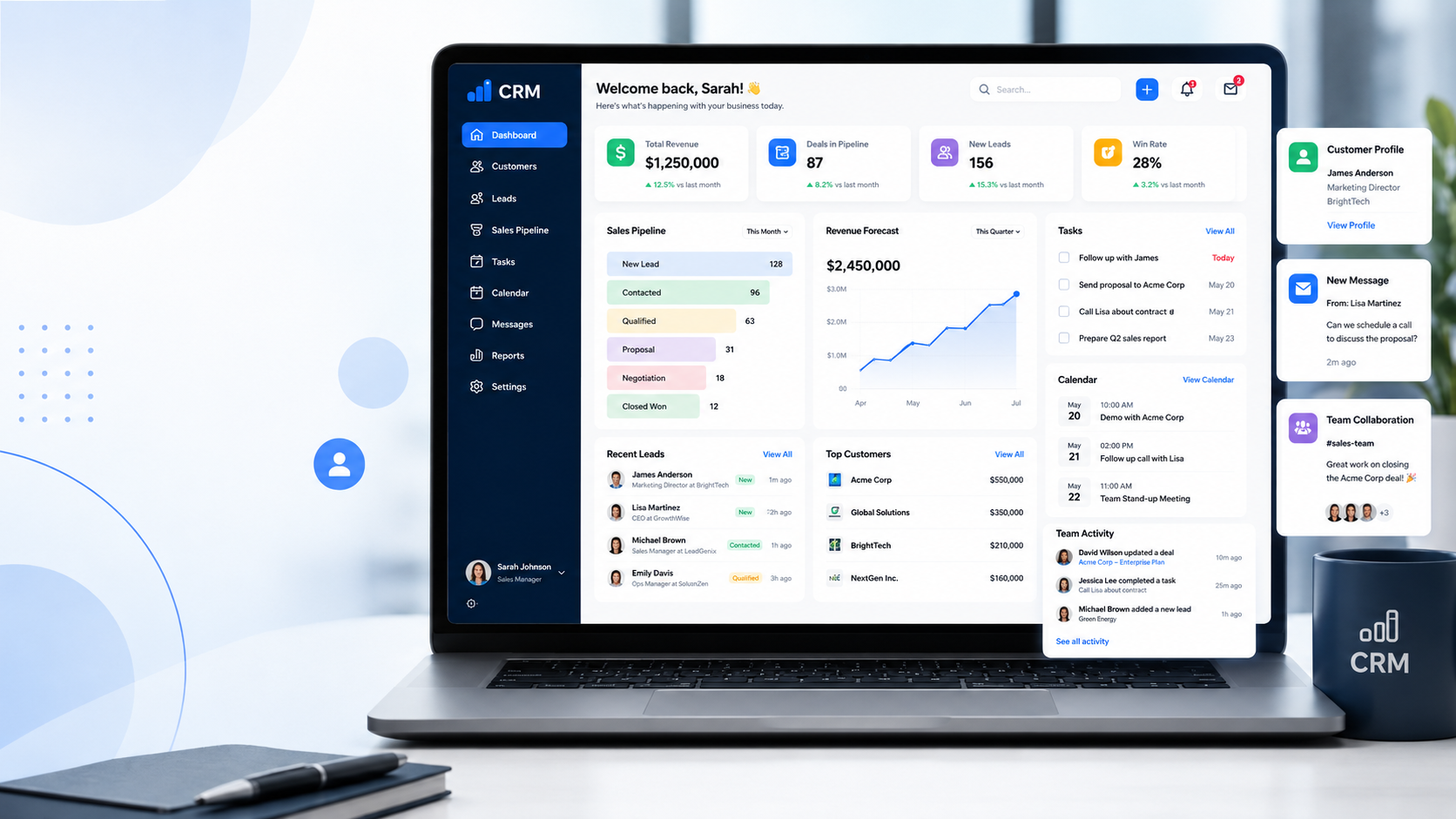
CRM tools are supposed to make customer relationships easier to manage. They store contacts, organize leads, track sales activity, and give teams a shared view of the people and companies they serve. But for many businesses, the CRM system becomes another place where data sits instead of a system that drives better decisions.
That is the gap this article explores. A CRM system is valuable, but it becomes far more useful when it is connected to marketing, sales, calls, POS, analytics, and revenue data. That is where AI marketing software changes the role of the CRM from a record-keeping tool into a decision-making engine.
What Are CRM Tools and Why Do They Matter?
Customer Relationship Management (CRM) tools are centralized software platforms designed to manage all interactions between a business and its customers. It serves as a digital headquarters where teams store contact information, track sales opportunities, and log communication history.
By organizing leads and automating follow-ups, a CRM helps businesses streamline operations and improve retention. Ultimately, it moves beyond simple record-keeping to provide actionable insights, ensuring that every department, from sales to support, has a unified view of the customer journey.
Stop letting data sit idle. Turn your CRM into a revenue-driving engine with Mackdata today
Connect Your CRM to Attribution Software
CRM Systems Turn Customer Data Into a Working Business Record
A CRM system collects and organizes customer data such as names, phone numbers, lead sources, deal stages, purchase history, and service records. This creates a working business record that can be used across teams.
That record helps answer practical questions:
- Which leads are new, qualified, or ready for follow-up?
- Which customers have already purchased, booked, or requested service?
- Which opportunities are still open in the sales pipeline?
- Which campaigns are creating real customer activity?
- Which accounts need attention before revenue is lost?
The value is not simply that the data exists. The value is that the data can guide action. When CRM tools are used well, they reduce guesswork and help teams respond faster, prioritize better, and create a more consistent customer experience.
The Core Elements of a Useful CRM Platform
A useful CRM platform usually includes several core elements. These features may look different across systems, but the purpose is similar: collect customer information, structure the sales process, and make follow-up easier.
Common CRM elements include:
- Contact management for storing customer and prospect details
- Lead management for tracking new opportunities
- Sales pipeline views for understanding deal progress
- Task and follow-up tracking for keeping teams accountable
- Marketing automation for emails, campaigns, and audience segments
- CRM reporting for pipeline, activity, and performance visibility
- Integrations with email, calendars, phone systems, ads, analytics, and payment tools
The problem is that these elements often describe activity rather than impact. They can show that a lead was created, a task was assigned, or a deal moved stages. But they do not always show whether marketing spend became a booked job, a closed deal, or a profitable sale.
Features are activity, but Mackdata provides the impact. Connect your core elements to real revenue
The Operational Framework: How a CRM Organizes Your Business
Every CRM system has a structure. Understanding that structure helps teams use the platform with more purpose instead of treating it as a digital filing cabinet. The best CRM tools are not just databases. They are operating systems for customer-facing work.
Lead, Contact, and Customer Management
Lead, contact, and customer management is the foundation of a CRM system. A lead might be someone who filled out a form, called the business, clicked an ad, or requested a quote. A contact is usually a person with a known relationship to the business. A customer is someone who has purchased, booked, closed, or completed a transaction.
The CRM should make these stages clear. If everyone uses different labels, reports become unreliable. If lead sources are missing, marketing attribution becomes weak. If customer records are duplicated, sales and service teams waste time.
A clean CRM system should define:
- What counts as a lead
- When a lead becomes qualified
- When a contact becomes a customer
- Which fields are required
- Which activities should be logged automatically
- Which systems are allowed to update CRM data
Sales Pipeline, Task, and Follow-Up Tracking
The sales pipeline serves as a visual map of the customer’s journey, tracking each opportunity as it moves from the initial inquiry through various stages toward a final sale. Pipeline tracking is useful because it turns scattered conversations into measurable stages. Teams can see what is moving, what is stuck, and what needs attention.
Task and follow-up tracking helps make that pipeline operational. A CRM system should show who owns the next step, when it is due, and what happened last. This reduces missed calls, forgotten proposals, and leads that quietly go cold.
The stronger the pipeline discipline, the more accurate the reporting. But pipeline data still needs context. A CRM can show how many opportunities exist, but it may not show which marketing campaign created the best opportunities unless it is connected to attribution data.
CRM Reporting, Dashboards, and Forecasting
CRM reporting helps leaders understand sales activity and customer behavior. Dashboards can be useful when they simplify decisions. They become less useful when they only display static numbers without explaining what to do next.
Forecasting is where the CRM system starts to become more strategic. If your CRM has enough clean historical data, it can help project future trends. This is especially valuable for businesses with seasonal demand, territory differences, local competition, or changing advertising costs.
Still, forecasting inside a CRM is often limited by the data the CRM can see. If ad spend, call tracking, POS data, website analytics, and booked revenue live elsewhere, the forecast may be incomplete. That is why CRM tools become more powerful when they are integrated with AI marketing attribution software.
Upgrade your operating system. Let Mackdata organize your CRM data into a clear growth roadmap
Why CRM Tools Often Fall Short Without Better Marketing Intelligence
Traditional CRM tools often provide a fragmented view of the business, focusing primarily on isolated data points like contacts and deals. Without connecting these to the complete customer journey—from initial ad click to final revenue—marketing teams struggle to identify which specific campaigns, keywords, or channels are actually driving growth.
How Do CRMs Fail Marketing Teams?
Lack of Marketing Attribution
CRMs typically show that a deal closed, but they rarely track the specific marketing touchpoints that influenced the journey. Without attribution, businesses cannot identify which ads, keywords, or campaigns earned the highest ROI, leading to inefficient budget allocation and guesswork.
Fragmented Data Silos
When CRMs operate independently from call tracking, POS systems, or ad platforms, data becomes siloed. This disconnection forces teams to manually piece together reports, making it nearly impossible to see a unified, real-time “source of truth” across the entire organization.
Focus on Quantity Over Quality
Most CRMs excel at counting lead volume but struggle to define lead quality. A system might report 500 new leads, yet fail to signal that those leads aren’t converting into revenue, causing teams to optimize for the wrong metrics.
Reporting Without Actionable Insights
Static CRM dashboards can show that performance is declining, but they rarely explain why. Without integrated intelligence, users are left digging through spreadsheets to determine if a dip was caused by seasonality, poor call handling, or a specific campaign’s failure.
Disconnect From the Full Journey
A CRM often misses the “before” and “after” of a sale. It might track the middle of the funnel but lose sight of the initial awareness stage or the operational data that follows, creating a narrow view of business health.
Closing the Loop: How Attribution Transforms CRM Data into Revenue Growth
AI marketing software makes CRM tools more effective by connecting customer records to the rest of the business. Mackdata does this by sitting on top of existing CRM, POS, call tracking, analytics, and marketing systems, then bringing that data together through Mack, its conversational AI marketing intelligence assistant.
This helps teams see the full customer journey, from first touchpoint to booked job, closed deal, completed sale, or repeat purchase.
Ready for growth? Let Mackdata transform your CRM activity into powerful, actionable revenue intelligence
Connect CRM Data With Ads, Calls, POS, and Analytics
CRM integration is the first step. Mackdata connects CRM data with ad platforms, call tracking, POS systems, website analytics, and marketing tools to create one source of truth.
Instead of replacing the CRM, Mackdata works with the systems teams already use. This gives home services, real estate, and retail businesses a clearer view of which campaigns, calls, customers, and sales activities are actually driving results.
Improve Attribution Across the Full Customer Journey
CRM tools often show what happened after a lead entered the system. AI marketing software connects that CRM activity to the marketing touchpoints that created it.
Mackdata does this through closed-loop attribution. It connects campaigns to outcomes such as qualified leads, booked jobs, closed deals, completed sales, and profitability. This helps teams move beyond clicks and form fills to understand which channels actually produce revenue.
Use AI to Forecast Demand, Revenue, and Campaign Performance
AI marketing software also improves forecasting by finding patterns across CRM data, lead volume, conversion rates, campaign performance, seasonality, and revenue trends.
Mackdata uses predictive intelligence to help teams look ahead instead of only reviewing past performance. Teams can see which services are gaining demand, which zip codes are producing better opportunities, and which campaigns are likely to support growth. That makes budget decisions more confident and less reactive.
Ask Natural-Language Questions Instead of Building Another Dashboard
Traditional CRM reporting often depends on dashboards, filters, exports, and custom reports. Mackdata makes CRM data easier to use through Mack, its natural-language AI assistant.
Teams can ask questions like: which campaigns created the most booked jobs, which zip codes produced the highest-value leads, which ad channels generated revenue, and which services need more budget. Mack turns connected CRM data into direct answers without another manual report.
Turn CRM Activity Into Revenue Intelligence
The real value of AI marketing software is that it turns CRM activity into revenue intelligence. CRM tools help teams manage customers, but AI marketing software helps teams understand what those customers mean for business performance.
Mackdata supports that shift by connecting customer data, campaign data, sales activity, calls, POS records, and revenue outcomes. The CRM still matters, but it becomes part of a smarter system for growth decisions.