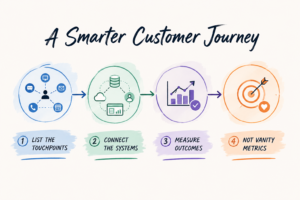
Home services marketing rarely follows a clean, one-click conversion path. A homeowner might see a Google ad, leave the site, call after reading reviews, come back through Local Service Ads, and finally book after a dispatcher follows up.
That is exactly why AI generated marketing attribution is becoming more important for contractors who need to understand what actually drives booked jobs instead of what simply generated a click.
In this guide, we’ll explore how modern attribution works in the context of home services, why traditional tracking methods fall short, and how AI-driven approaches can connect your marketing efforts directly to booked jobs and revenue. We’ll also break down the key components of an effective attribution setup and what to look for when choosing the right solution for your business.
Why Home Service Companies Need Better Attribution Now
Traditional reporting is too narrow for modern contractor marketing. It often gives credit to the final touchpoint while ignoring the earlier interactions that built intent. For HVAC, plumbing, electrical, roofing, and other field service businesses, that creates a costly blind spot.
You can end up scaling the wrong campaigns, underfunding strong channels, and making budget decisions based on incomplete data.
This is where modern attribution changes the conversation. Instead of asking which ad platform reported the lead, you start asking which marketing activity helped produce the booked job, the completed job, and the revenue behind it.
Mackdata helps home service companies connect ad spend, calls, CRM activity, and booked revenue into one view of marketing performance.
What Is AI Generated Marketing Attribution?
AI generated marketing attribution uses machine learning, automation, and connected data systems to assign value across the real customer journey. Rather than relying on a rigid first-click or last-click model, it looks at patterns across touchpoints and helps marketers understand how channels assist, influence, and close business.
For home services, that matters because the path to conversion is rarely linear. A customer may:
- Search for a service problem
- Visit your website from a paid or organic result
- Leave without filling out a form
- Return later after seeing a retargeting ad
- Call your business
- Book a service appointment
- Convert into actual revenue days later
A basic dashboard may only report the final click. An AI-driven attribution approach tries to connect the full sequence.
The Difference Between Old Attribution and Modern Attribution
Older attribution models are easy to understand, but they are often too simplistic for local service businesses.
- First-touch attribution over-rewards awareness channels
- Last-touch attribution over-rewards bottom-funnel conversions
- Linear attribution treats all touchpoints as equally influential
- AI-assisted attribution evaluates patterns across real journeys and business outcomes
That difference becomes especially important when your leads come from phone calls, branded searches, map listings, referrals, remarketing, and CRM follow-up rather than a single ecommerce checkout flow.
Why Attribution Is Harder in Home Services
Home services marketing has operational complexity that many generic analytics tools do not handle well. The sale does not happen the moment someone clicks an ad. It often depends on call quality, dispatch timing, technician availability, service area fit, urgency, and the customer’s trust in your brand.
Booked Jobs Matter More Than Leads
A lead is not the same thing as a booked job. And a booked job is not always the same thing as collected revenue. If your reporting stops at form fills or phone calls, you are missing the numbers that matter most.
A modern attribution setup should help you answer questions like:
- Which channels drive the lowest cost per booked job?
- Which campaigns generate the highest-value service calls?
- Which zip codes produce profitable demand?
- Which sources create repeatable revenue instead of low-quality lead volume?
Offline and Online Touchpoints Need to Work Together
Home services marketers also deal with channels that do not fit neatly inside ad platform dashboards. Direct mail, local radio, branded search, Google Business Profile activity, call tracking, and CRM follow-up all influence performance. If those signals remain disconnected, attribution becomes guesswork.
Modern attribution for home services should connect channels, calls, booked jobs, and revenue into one source of truth.
Talk to our Experts at Mackdata
Mackdata’s Modern Attribution Stack for Home Service Businesses
For AI-generated attribution to produce useful answers, your system must be solid. AI cannot fix fragmented data alone; it thrives when your tracking foundation is clean. With Mackdata, you ensure your data is connected, turning messy inputs into actionable insights that actually drive growth.
1. Centralized Marketing and CRM Data
The first requirement is data centralization. Your ad platforms, website analytics, call tracking software, CRM, and job management system need to feed into the same environment. Without that, attribution models only see part of the picture.
2. Identity Resolution Across the Customer Journey
Modern attribution is only as good as its ability to recognize one customer journey across multiple touchpoints. A visitor may come from paid search, later call from a mobile device, and then appear in your CRM under a slightly different record. AI-assisted systems like Mackdata help unify those interactions into one journey.
3. Call Tracking and Lead Qualification
Phone calls remain one of the most important conversion points in home services. That means attribution should not stop at click tracking.
A stronger setup includes:
- Campaign-level call tracking
- Source and medium capture
- Call outcome classification
- Lead quality scoring
- Booked-job confirmation
When those signals are connected, you can see not just which channel generated a call, but which one generated a qualified opportunity.
4. Revenue-Based Attribution
Modern attribution becomes truly useful when it moves beyond lead reporting and connects to revenue outcomes. That lets marketing leaders compare channels by business result, not by vanity metric.
Instead of optimizing around cheap leads, you can optimize around:
- Cost per booked job
- Revenue by channel
- Close rate by campaign
- Average ticket by source
- Return on ad spend tied to real outcomes
How AI-Revenue Intelligence Improves Attribution Decisions
The value of AI is not that it replaces judgment. It is that it speeds up pattern recognition and makes complex marketing data usable for decision-making.
AI Surfaces Patterns Humans Miss
When you are running multiple campaigns across paid search, Local Service Ads, paid social, SEO, direct mail, and branded traffic, hidden relationships start to matter. AI can help identify which touchpoint combinations tend to produce better jobs, stronger close rates, or higher-value customers.
AI Makes Attribution More Actionable
The biggest advantage of an AI marketing attribution platform is usability. Instead of forcing your team to manually pull spreadsheets, compare dashboards, and interpret conflicting reports, the platform can translate marketing complexity into practical answers.
That means marketers and operators can ask better questions, such as:
- Which source is driving the best booked-job rate this month?
- Which campaign is filling the schedule in our highest-margin service area?
- Where are we overpaying for low-quality demand?
- Which channels should get more budget next month?
Mackdata turns fragmented home services marketing data into usable answers that help teams scale what is actually working.
What to Look for in an AI Marketing Attribution Platform
Not every attribution solution is built for the way home service companies operate. If your business depends on calls, scheduling, technician capacity, and local market coverage, the platform should reflect that.
Look for These AI Capabilities:
A strong platform should include:
- Multi-touch attribution across the customer journey
- Call tracking integration
- CRM and dispatch system connectivity
- Booked-job and revenue visibility
- Channel-level performance comparisons
- Geographic performance insights
- Platform-agnostic integrations
- AI-driven analysis that supports real decisions
Avoid These Common Gaps
Be cautious of tools that only aggregate ad-platform metrics or stop reporting at the lead stage. If the system cannot connect marketing activity to operational outcomes, it will still leave major questions unanswered.
Mackdata: The Future of Marketing Attribution in Home Services
The future of home services marketing isn’t about collecting more data—it’s about turning that data into clear, revenue-focused decisions. Mackdata leads this shift by connecting marketing, calls, CRM activity, and booked jobs into one AI-powered attribution platform. Instead of fragmented reporting, businesses gain a unified view of performance, enabling faster decisions, smarter budget allocation, and continuous optimization across the entire customer journey.
The Benefits of Mackdata’s AI-Revenue Intelligence Platform Include:
Full Visibility from Click to Booked Job
Mackdata connects every stage of the customer journey—from initial ad click to final booked job—so nothing gets lost in disconnected systems. This gives teams a true understanding of which campaigns actually generate revenue, not just leads or surface-level engagement metrics.
Smarter Budget Allocation with AI Insights
With AI-driven analysis, Mackdata identifies which channels, campaigns, and touchpoints are driving the highest-quality jobs. This allows home service businesses to confidently shift budget toward what’s working, reduce wasted spend, and scale campaigns that consistently produce profitable outcomes.
Unified Data Across Marketing and Operations
Mackdata brings together marketing platforms, call tracking, CRM systems, and job data into a single source of truth. By eliminating data silos, teams can align marketing performance with real operational results, making attribution clearer, reporting simpler, and decision-making far more effective.