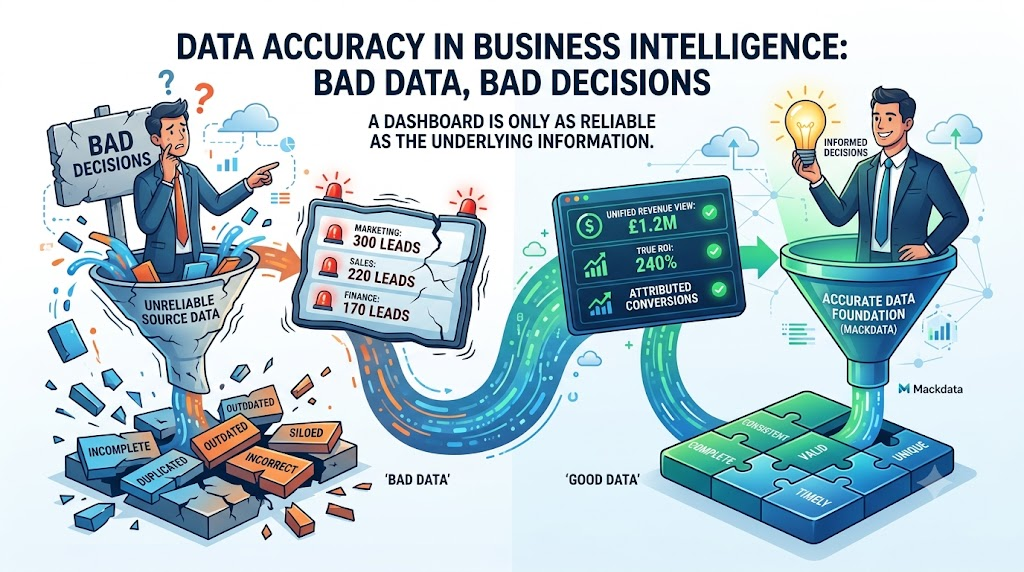
Business intelligence is only as reliable as the information beneath it. A dashboard may look polished, a report may include dozens of performance metrics, and an artificial intelligence system may return an answer in seconds. None of that matters when the underlying data is incomplete, duplicated, outdated or incorrect.
Data accuracy determines whether the values stored across a business reflect what actually happened. It affects every conclusion a company draws from its CRM, marketing platforms, call-tracking software, point-of-sale systems and financial records.
When those systems disagree, business leaders do not simply face a technical inconvenience. They risk making confident decisions based on false insights.
What Data Accuracy Means in Business Intelligence
Data accuracy measures how closely recorded information reflects a real-world value, event or outcome. An accurate customer record contains the correct contact information. An accurate sales report reflects actual transactions. An accurate attribution model connects marketing touchpoints to the revenue they genuinely influenced.
Accuracy is one part of the wider concept of data quality. High-quality data must also demonstrate:
- Completeness, with the necessary fields and records present
- Consistency across connected systems and reports
- Validity according to established formats and business rules
- Timeliness, so information remains current enough for its intended use
- Uniqueness, without duplicate records inflating totals
- Relevance and fitness for purpose for the decision being made
Reliable business intelligence depends on all these dimensions working together. Accuracy answers whether the data is correct. The remaining dimensions determine whether it is complete, usable and appropriate for the analysis.
Achieve flawless data quality effortlessly. Partner with Mackdata to unlock true business intelligence now
Explore Our AI Marketing Attribution Software
How Bad Data Corrupts Business Decisions
Bad data rarely stays contained within one spreadsheet or platform. Once inaccurate information enters a connected reporting environment, it can spread through calculations, dashboards, forecasts and automated recommendations.
The resulting report may appear authoritative because the software processed the information correctly. The problem is that it processed the wrong information.
Inaccurate Source Data Creates Misleading Analysis
Most organisations collect information from multiple data sources. A single customer journey might generate records in an advertising platform, website analytics account, CRM system, call-tracking tool, payment platform and sales database.
Each connection creates an opportunity for error. Common causes include:
- Human error during manual data entry
- Missing values or incomplete customer records
- Duplicate records created in separate systems
- Inconsistent formats, naming conventions or date structures
- Broken integrations and failed data transfers
- Outdated information that remains active
- Mismatched customer identities across channels
Consider a home services company that receives a phone call from a paid search advertisement. The advertising platform records the click, the call-tracking system records the call, and the CRM records the booked appointment. If those records are not matched correctly, the campaign may receive no credit for the booked job.
The marketing team could then reduce spending on a profitable campaign because its reporting shows poor performance. The analysis is mathematically correct, but the source data is incomplete.
Conflicting Dashboards Undermine Decision Confidence
When departments use different definitions, systems and reporting windows, they may produce conflicting versions of the same metric. Marketing reports 300 qualified leads, sales records 220, and finance recognises revenue from only 170.
Each team may have valid reasons for its total, but executives are left asking which number represents reality.
Conflicting dashboards create several problems:
- Meetings focus on reconciling numbers instead of improving performance.
- Managers begin making decisions from whichever report supports their assumptions.
- Employees lose confidence in business intelligence tools.
- Forecasting becomes less reliable because historical baselines are inconsistent.
- Automated systems repeat the same errors at greater speed.
This uncertainty weakens decision confidence. Leaders may delay necessary changes because they do not trust the evidence, or act too quickly because one dashboard presents an incomplete view.
Don’t let broken tracking ruin your ROI. Let Mackdata unify your marketing sources perfectly
(CTA: Make Better Business Decisions with Mackdata
The Hidden Business Cost of Poor Data Quality
The consequences of bad data extend beyond reporting accuracy. They affect revenue, productivity, customer experience and strategic planning.
A typical chain of impact looks like this:
- An error enters a source system. A lead is duplicated, a sale is attributed to the wrong campaign, or a customer record contains incomplete information.
- The error flows into a central report. Data integration or transformation processes carry the incorrect value into dashboards and analytical models.
- The report produces a false insight. A channel appears less profitable, a territory seems less active, or a customer segment looks larger than it is.
- The business takes the wrong action. Budget is reduced, resources are moved, or a campaign is expanded based on misleading analysis.
- The decision creates a financial impact. The company loses revenue, wastes budget, increases operational costs or misses a viable opportunity.
Poor data quality also consumes time. Data analysts and operational teams may spend hours reconciling spreadsheets, fixing customer records and explaining why reports disagree. This reduces productivity and delays access to meaningful information.
Stop bleeding cash on bad leads. Book your Mackdata demo to protect your margins
Improve Your ROI With Better Marketing Data
How to Improve Data Accuracy Across Connected Systems
Improving data accuracy is not a one-time cleanup project. Information continually changes as customers update their details, teams adopt new tools, campaigns launch and transactions move through different systems.
Organisations need a repeatable data management process that prevents errors, identifies anomalies and corrects problems before they shape important decisions.
Use Data Validation, Cleansing and Continuous Monitoring
A strong data-quality process begins before information reaches a dashboard. Validation rules should check whether records follow the expected structure and whether required fields have been completed.
Practical controls include:
- Standardising dates, phone numbers, addresses and campaign names
- Preventing incomplete records from entering key workflows
- Using deduplication and record matching to merge repeated profiles
- Checking values against accepted business rules
- Flagging unusual changes through anomaly detection
- Monitoring failed integrations and delayed data transfers
- Reviewing source-system accuracy at defined intervals
Data cleansing then corrects existing errors, removes duplication and standardises inconsistent formats. This is important, but cleansing alone is not enough. If the process that introduced the error remains unchanged, dirty data will quickly return.
Continuous monitoring helps data teams detect problems closer to the moment they occur. Instead of discovering a broken CRM connection during a monthly performance review, the business can identify the interruption while the data gap is still small.
Build Data Governance Around a Single Source of Truth
Data governance defines how information is collected, stored, accessed, maintained and interpreted. It gives the organisation shared standards rather than allowing every department to develop its own version of a metric.
An effective governance framework establishes:
- Clear ownership for important datasets
- Agreed definitions for leads, conversions, customers and revenue
- Rules for entering, updating and deleting records
- Access controls and accountability
- Processes for resolving conflicting values
- Documentation of data lineage and transformations
- Regular data profiling and quality reviews
A single source of truth does not necessarily mean every team must work inside one software platform. It means the business has an agreed, governed view that brings relevant systems together and resolves inconsistencies.
This is particularly important for attribution. Marketing platforms often claim conversions independently, which can cause several channels to receive full credit for the same customer. A governed identity and attribution framework helps the organisation recognise the full journey without counting the same revenue repeatedly.
Connect CRM, Marketing and Revenue Data With Mackdata
Mackdata is designed to sit above existing CRM, advertising, call-tracking, POS and analytics platforms. Instead of asking teams to replace every system, it brings fragmented business data into a connected intelligence layer.
That connection supports:
- Identity resolution across customer touchpoints
- Cross-system verification of leads and transactions
- Closed-loop attribution from marketing activity to revenue
- Consistent performance metrics across departments
- Real-time insights delivered through conversational AI
- Forecasting based on unified historical information
For a home services business, this can mean connecting an advertisement to a phone call, booked appointment, completed job and final revenue value. For a real estate investor, it can mean tracing acquisition spend through to a closed deal. For a retailer, it can connect cross-channel campaigns to customer visits and sales.
The goal is not simply to collect more data. It is to create accurate business intelligence that produces a clear next action.
Connect your operational, customer and marketing data so Mack can answer questions using the same trusted view of performance
Build Business Intelligence on Data You Can Trust
Business intelligence should reduce uncertainty, not create another version of it. That requires more than dashboards and reporting software. It requires accurate data, consistent definitions, reliable integrations and clear governance across the full information lifecycle.
When businesses establish that foundation, analytics becomes more useful. Teams can identify performance trends, improve operational efficiency, allocate budgets more confidently and connect marketing activity to measurable revenue.
Mackdata helps organisations bring fragmented systems together so decision-makers can move from conflicting reports to a unified view of what is working.