Navigating modern digital marketing requires a clear understanding of campaign efficiency, and few metrics are as foundational as Cost Per Lead (CPL). However, relying purely on front-end numbers can skew your strategy and mask true profitability.
This comprehensive guide breaks down exactly how to navigate this crucial metric to fuel sustainable growth. We will establish a clear definition of CPL, outline the standard formula for accurate calculations, and contrast it with adjacent growth marketing benchmarks. Finally, we will explore advanced optimization tactics, detailing how moving toward a closed-loop attribution model ensures your lead data directly maps to actual business revenue.
What is Cost Per Lead in Marketing?
Cost per lead is a marketing metric that shows how much you spend to generate one lead. It is usually shortened to CPL, and it helps marketers understand whether campaigns are producing interest at a sustainable cost.
That lead might come from a form submission or phone call. It might also come from a quote request, booked consultation, demo request, or another conversion event. But CPL is only useful when the business also understands what happened after the lead arrived.
A low CPL looks good on a report, but revenue decides whether the campaign actually worked.
Maximize your efficiency. Use Mackdata to turn total spend into measurable pipeline success
Ensure Business Success With Mackdata
Cost Per Lead vs. Lead Generation Cost
Cost per lead and lead generation cost are closely related, but they are not always used the same way. Lead generation cost describes total campaign spend, while cost per lead divides that spend by the number of leads created.
For example, if a business spends $5,000 and generates 100 leads, the CPL is $50. The total spend shows the budget commitment. The CPL gives the team a clearer benchmark for campaign efficiency.
This distinction matters because a cheaper lead is not always a better lead. The real value comes from understanding which leads become qualified opportunities and revenue.
Why CPL Matters for Marketers, Sales Teams, and Business Owners
CPL matters because it connects marketing activity to lead volume. For marketers, it shows whether campaigns are generating interest efficiently. For sales teams, it gives more context around the value of each inquiry. For business owners, it turns ad spend into a more measurable business decision.
But CPL should never be treated as the final score. A campaign with a $30 CPL can be weaker than a campaign with a $90 CPL if the cheaper leads are unlikely to convert.
That is why CPL works best when it is connected to revenue. Mackdata helps businesses move beyond surface-level lead cost by connecting campaign data to CRM records, call tracking, booked jobs, closed deals, and completed sales.
How to Calculate Cost Per Lead
To calculate cost per lead, divide total campaign spend by the number of leads generated during the same campaign period. The formula is simple, but the quality of the data behind it determines whether the result is useful.
The most common problem is that businesses calculate CPL from ad platform data alone. That can show clicks or form submissions, but it may not reveal which leads became qualified opportunities, booked jobs, or revenue.
Cost Per Lead Formula
The cost per lead formula is:
Total marketing spend ÷ Total number of leads = Cost per lead
If a campaign costs $3,000 and generates 75 leads, the calculation is:
$3,000 ÷ 75 = $40 CPL
That means the business paid $40 for each lead. The next question is whether those leads were valuable enough to justify the spend.
The formula should be applied consistently. Use the same reporting period, the same lead definition, and the same spend source each time. Otherwise, CPL becomes difficult to compare across campaigns.
Cost Per Lead Examples Across Common Marketing Campaigns
CPL can be used across nearly every lead generation channel, from PPC and paid social to webinars, local service ads, landing pages, and phone campaigns.
Here is a simple comparison:
- Google Ads spends $3,000 and generates 60 leads, creating a CPL of $50.
- Facebook spends $1,500 and generates 75 leads, creating a CPL of $20.
- A webinar spends $2,000 and generates 40 leads, creating a CPL of $50.
- Local services ads spend $4,000 and generate 50 phone leads, creating a CPL of $80.
At first glance, Facebook looks best. But what if only two leads are qualified? What if Google Ads produces booked jobs, closed deals, or repeat customers? That is where cost per lead becomes too shallow on its own.
Don’t rely on basic formulas. Partner with Mackdata to uncover deeper lead quality insights
Start Understanding Accurate Marketing Insights
What CPL Can Tell You About Campaign Performance
CPL can show whether a campaign is producing leads at an affordable rate. It helps marketing teams spot budget issues, compare channels, and decide which campaigns deserve closer review. Used properly, CPL is a useful early-stage campaign performance metric.
The key phrase is early-stage. CPL tells you what it costs to create a lead. It does not tell you whether the lead was qualified, whether sales followed up, whether the prospect converted, or whether the campaign produced sales revenue.
How CPL Compares With CPA, CPC, CPM, CAC and ROI
CPL sits inside a larger family of traditional metrics:
- CPC measures cost per click
- CPM measures cost per thousand impressions
- CPA measures cost per acquisition or action
- CAC measures customer acquisition cost
- ROI compares return against investment
CPL is more meaningful than impressions or clicks because it measures an action closer to the sales pipeline. But it is usually less meaningful than CAC or revenue-based attribution because it stops before the commercial outcome.
When a Low Cost Per Lead Is Actually Useful
A low cost per lead is useful when lead quality is stable and conversion rates are predictable. If a home services company knows that 30 percent of qualified calls become booked jobs, lowering CPL can improve profitability. If a real estate acquisition team knows which lead sources produce profitable deals, CPL can help manage spend more efficiently.
Why Cost Per Lead Can Mislead Your Business
The main issue with cost per lead is that it measures cost before it measures value. It tells you how cheaply you created a lead, not whether that lead helped the business grow. That creates a reporting problem for marketing leaders who need to defend budget, allocate spend, and prove impact on the bottom line.
A Lead Is Not the Same as Revenue
A lead is an expression of interest. Revenue is a business outcome. Confusing the two can distort decision-making.
Imagine two campaigns. Campaign A generates 200 leads at $25 each. Campaign B generates 50 leads at $80 each. If you only look at CPL, Campaign A wins. But if Campaign B generates 20 closed deals and Campaign A generates five, Campaign B is the stronger investment.
Mackdata’s marketing software is built around tracking ad spend through to closed deals because deal quality matters more than inquiry volume.
CPL Misses the Full Customer Journey
Most customers do not convert after one touchpoint. They may see a paid ad, return through organic search, call from a local listing, compare competitors, then submit a form days later. If your reporting only credits the final lead source, CPL can misread the customer journey.
This is where cross-channel performance reporting becomes essential. A campaign might look expensive when judged by direct CPL, but valuable when you see its role in assisted conversions, repeat engagement, or high-value opportunities.
Get the complete picture. Let Mackdata reveal the exact revenue your campaigns actually generate
Start Tracking Leads to Booked Jobs
Use Closed-Loop Attribution to Judge Lead Quality
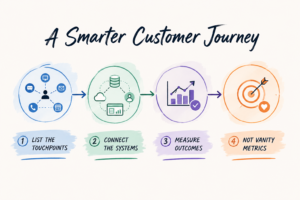
Closed-loop attribution connects marketing touchpoints to sales outcomes. Instead of stopping at the lead, it follows the journey through CRM activity, sales follow-up, booked appointments, closed deals, POS transactions, or completed jobs. That gives operators a more complete view of lead quality.
For Mackdata, this changes the question from “How many leads did we get?” to “Which campaigns produced revenue we can trust?”
Connect CRM, Call Tracking, POS, and Ad Platform Data
CPL becomes more useful when it is connected to the systems where business outcomes happen. Ad platforms show spend and clicks. Call tracking shows phone leads. CRM systems show pipeline stage and deal status. POS systems show completed purchases.
Mackdata sits on top of existing CRM, POS, call-tracking, analytics, and marketing systems, turning fragmented reporting into one source of truth. Our marketing attribution software helps connect marketing activity to revenue outcomes.
Measure Revenue Per Lead Instead of Cost Alone
Revenue per lead changes the question from “What did this lead cost?” to “What did this lead return?”
That shift is critical for businesses that depend on offline outcomes. A plumber may want to track booked jobs. A roofer may want to see which zip codes produce high-value estimates. A retailer may want to connect omnichannel campaigns to POS revenue.
Stop chasing empty inquiries. Let Mackdata instantly connect your ad spend to closed deals
Achieve True ROI Clarity with Mackdata
Stop guessing which marketing channels actually grow your bottom line. While standard CPL metrics only scratch the surface, Mackdata’s advanced marketing attribution software bridges the gap between initial ad spend and final revenue.
By seamlessly integrating your CRM, call tracking, and POS systems, we deliver a single, unified source of truth. Our platform empowers your team to move past raw lead volume, allowing you to optimize campaigns for qualified opportunities, booked jobs, and closed deals. Experience data-driven clarity and maximize your marketing ROI with Mackdata today.