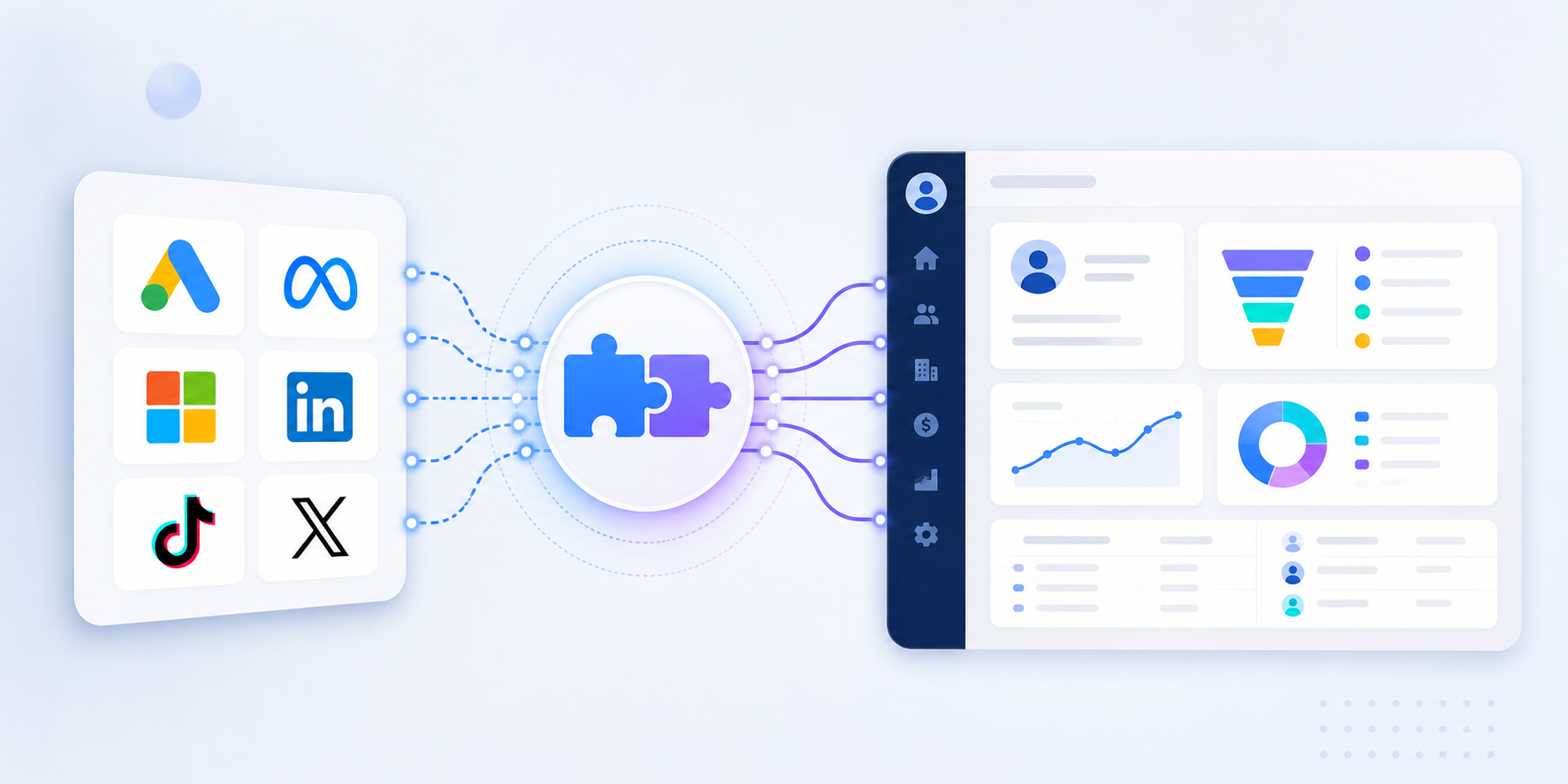
Yes, you can integrate advertising platforms with CRM systems, and for many businesses, that connection is now essential. Advertising data shows where attention begins. CRM data shows what happens after a lead enters the business. When those systems stay separate, marketing teams see campaign activity while sales teams manage customer records in another place.
The result is fragmented reporting, weak attribution, and unclear revenue visibility. A connected CRM gives teams a cleaner way to track lead source data, campaign performance, sales pipeline activity, and revenue outcomes from one customer journey.
What Is A CRM System?
A CRM system manages customer relationship management across leads, contacts, deals, tasks, and customer records. It helps teams see where prospects came from, what stage they are in, and what should happen next. When connected to advertising data, CRM records become more useful for reporting, attribution, sales pipeline visibility, and revenue intelligence.
Supercharge your CRM with rich advertising data to fuel smarter revenue tracking
Merge Your CRM and Advertising Channels
Can You Integrate Advertising Systems With CRM Systems?
Yes. Most modern advertising systems can be connected to CRM systems through native CRM integration, or third-party integrations. The right integration method depends on the ad platform, the CRM software, the quality of your data, and the level of automation you need.
A basic advertising platform integration may send new leads into contact records. A more advanced CRM integration can sync campaign tracking, offline conversion import, deal records, revenue attribution, and closed-loop attribution. This is where marketing attribution software becomes valuable because it connects campaign activity to business outcomes rather than stopping at form fills or clicks.
What Ad Platforms Can Be Integrated With A CRM?
Many ad platforms can be integrated with a CRM when the right data sync is in place. The goal is to move useful advertising data into CRM records without creating manual updates.
- Google Ads
- Meta Ads
- Facebook Lead Ads
- LinkedIn Ads
- Microsoft Ads
- TikTok Ads
- YouTube Ads
Unify your omni-channel campaigns into one powerhouse CRM dashboard for maximum clarity
Why Should You Connect Advertising Platforms With Your CRM?
Connecting advertising platforms with your CRM helps teams understand what happens after someone becomes a lead. Instead of judging campaign performance through vanity metrics, the business can compare ad spend with contact quality, deal progress, sales activity, and revenue outcomes.
You Can Track Leads Back To The Campaign That Created Them
When CRM and advertising data are connected, lead source mapping becomes much clearer. A team can see whether a lead came from paid search, paid social, a remarketing campaign, or another advertising source.
This improves campaign tracking because the CRM record carries more context. UTM tracking, first-party data, and contact records help marketers understand which campaigns are creating real sales opportunities. That is stronger than only measuring clicks or impressions.
You Can Improve Sales And Marketing Alignment
Sales and marketing alignment becomes easier when both teams work from connected data. Marketing teams can see whether campaigns are producing qualified leads. Sales teams can see which lead sources are driving stronger conversations.
This helps reduce confusion across the lead lifecycle. If sales reps update CRM records consistently, marketers can adjust campaigns based on pipeline quality rather than lead volume alone. That creates a more reliable feedback loop between advertising activity and sales execution.
You Can Reduce Manual Data Entry And Reporting Gaps
Manual data entry creates delays and mistakes. When a team has to copy lead data from one system into another, data discrepancies become more likely. A proper data sync reduces that burden and helps keep CRM records accurate.
Connected workflows also reduce reporting gaps. Instead of manually combining campaign exports with CRM reports, teams can use a connected system to monitor campaign performance more consistently.
You Can Understand Which Campaigns Create Revenue
The biggest benefit of CRM integration is revenue attribution. A campaign may create many leads, but the better question is whether those leads become booked jobs, closed deals, or completed sales.
Closed-loop attribution connects ad spend with revenue outcomes. It helps a business understand which campaigns influence the full customer journey. This makes advertising reporting more useful because the team can judge campaigns by revenue clarity instead of activity alone.
You Can Make Better Budget Allocation Decisions
Better budget allocation depends on better data. If one campaign creates low-cost leads but weak revenue, it may not deserve more spend. If another campaign creates fewer leads but stronger revenue outcomes, it may be the better growth channel.
Connected CRM data also supports forecasting. When campaign performance, sales pipeline movement, and revenue data work together, leaders can make more confident advertising ROI decisions.
Stop wasting budget on vanity metrics and start measuring advertising by true revenue generated
Experience the Benefits of a Connected System
How To Integrate Advertising Platforms With CRM Systems
Integrating advertising platforms with CRM systems should follow a clear process. The goal is not simply to connect tools. The goal is to create a reliable flow of advertising data, CRM data, and revenue data that supports better business intelligence.
Audit Your Current CRM And Advertising Data
Review your CRM alongside ad accounts and analytics tools to uncover where lead data disconnects. This audit checks data quality because incomplete records or poorly configured pipelines carry forward. Fixing foundational flaws first ensures your final integration is built on reliable information rather than compounding existing reporting errors.
Define The Outcomes You Need To Track
Before choosing an integration method, pinpoint the specific business milestones that drive revenue. Focus on tracking essential targets such as booked appointments, closed deals, completed jobs, or customer lifetime value. This clarity keeps the integration targeted, preventing teams from mindlessly syncing unnecessary fields that fail to support strategic decision-making.
Choose The Right Integration Method
There are several ways to connect CRM and advertising systems. The best option depends on complexity, data volume, and the platforms involved.
- Use a native CRM integration when the platform already supports the connection.
- Use pre-built integrations when standard app connectors can handle the workflow.
- Use a custom integration when the business needs deeper API control.
- Use offline conversion import when revenue data must return to ad platforms.
- Use a platform like Mackdata when multiple systems need unified reporting.
This is where software like Mackdata becomes especially useful. Instead of treating integration as a one-time technical task, Mackdata helps turn connected data into ongoing business intelligence.
Sync Revenue Data Back To Your Advertising Reports
A strong integration should not only push advertising data into the CRM. It should also help revenue data move back into advertising reports where possible. This is often done through offline conversion import or two-way sync.
This feedback loop helps ad platforms optimize toward stronger business outcomes. It also helps internal teams compare campaign spend with confirmed revenue.
Use Mackdata To Turn The Integration Into Business Intelligence
Mackdata sits on top of existing CRM, marketing, POS, call tracking, and analytics systems. That matters because many businesses do not need another dashboard. They need connected data that answers practical business questions.
With Mackdata, teams can connect CRM data and advertising data into a broader revenue intelligence layer. For home services teams, home services marketing software can help connect leads, calls, booked jobs, and revenue. For acquisition teams, real estate marketing software can help track ad spend through deal outcomes. For omnichannel sellers, retail marketing software can support cross-channel marketing attribution.
H5:Streamline your connection process to turn fragmented data into profitable business intelligence
How Mackdata Turns Connected Data Into Revenue Intelligence
Mackdata turns CRM and advertising integration into a more complete revenue intelligence system. It is designed for businesses that need to connect fragmented reporting and understand what is really driving growth.
The Benefits of Advertising Attribution Software
Mackdata Connects Data Across Existing Business Systems
Mackdata is platform-agnostic, which means it is built to sit on top of existing business systems rather than replace them. It can connect data from CRM, POS, call tracking, analytics, and marketing tools.
That matters because revenue often lives across multiple systems. Advertising platforms may show campaign performance. The CRM may show lead management. The POS may show completed sales. Call tracking may show phone leads. Mackdata connects those pieces into one clearer source of truth.
Mack Helps Teams Ask Better Questions Of Their Data
Mack is Mackdata’s conversational AI assistant. Instead of forcing teams to dig through dashboards, Mack helps users ask direct questions about campaign performance, lead quality, revenue outcomes, and forecasting.
This makes analytics more practical. A marketing leader can ask what changed. An operator can ask which territory is underperforming. A business owner can ask which campaigns are creating revenue clarity.
Closed-Loop Attribution Links Ad Spend To Revenue Outcomes
Closed-loop attribution is where CRM integration becomes commercially powerful. Mackdata helps connect ad spend to booked jobs, closed deals, completed sales, and other revenue outcomes.
This gives teams a clearer view of advertising ROI. It also helps reduce reliance on vanity metrics because the business can see which campaigns are producing measurable value.