Generating more enquiries does not automatically produce more sales. A campaign can deliver hundreds of calls, form submissions or messages while creating very few genuine opportunities for the sales team.
Lead quality describes how likely an incoming prospect is to become a valuable customer. It considers whether the person is a suitable fit, has a genuine need, intends to buy and has the potential to generate profitable revenue.
This makes lead quality more commercially useful than lead volume alone. A business may reduce its total number of leads while increasing booked jobs, closed deals and revenue because the remaining enquiries are more relevant and conversion-ready.
What Does Lead Quality Mean?
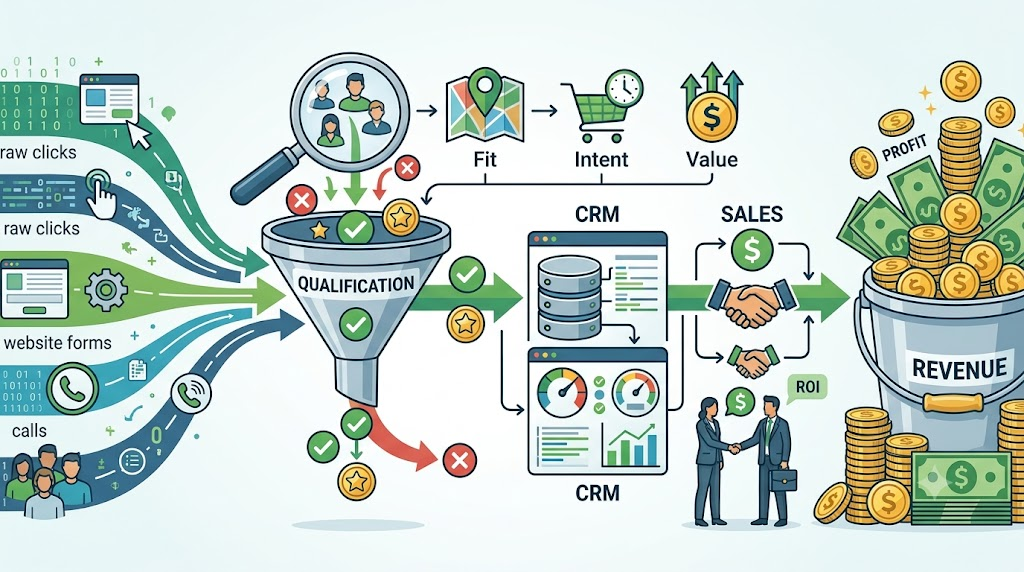
Lead quality measures a prospect’s potential commercial value. A high quality lead fits your target profile and shows genuine buying intent, rather than just submitting contact info. While marketing flags potential using demographics and behavior, sales validates budget and authority.
True quality is proven by conversion. Ultimately, the best analysis connects early marketing signals with CRM data and actual revenue outcomes to track progress from inquiry to a closed deal.
Turn raw traffic into closed deals. See how Mackdata tracks every touchpoint effortlessly
What Makes A Lead High Quality?
A high-quality lead usually performs well across three dimensions: fit, intent and potential value. A prospect does not need to be perfect in every category, but stronger performance across these areas increases the probability of conversion.
- Businesses can assess incoming lead quality by asking:
- Does this person match the customers we serve successfully?
- Have they demonstrated a real need for the product or service?
- Are they actively considering a purchase?
- Can the sales team realistically convert the opportunity?
- Could the customer generate sufficient revenue or long-term value?
These questions prevent sales teams from treating every enquiry as equally important.
Fit: Does The Lead Match Your Ideal Customer Profile?
Fit evaluates how closely a prospect matches a successful customer profile based on location, budget, or industry. A clear ideal customer profile gives marketing and sales a unified standard for review. Poor-fit inquiries inflate lead volume but never generate revenue because they fall outside service areas or lack required resources. Filtering these unsuitable prospects allows sales teams to prioritize viable opportunities instead of chasing leads destined to fail.
Intent: Is The Prospect Ready To Take Action?
Fit alone doesn’t mean a prospect is ready to buy; they might just be researching. Intent measures action through behavioral signals like visiting pricing pages, requesting quotes, or calling about specific problems. While lead scoring ranks these actions, not all engagement is equal. Downloading a basic guide shows weak intent compared to booking a consultation. Combining behavioral signals with CRM data reveals if a prospect is genuinely conversion-ready.
Value: Is The Lead Likely To Generate Profitable Revenue?
Two qualified leads can have very different commercial values. One may produce a small, one-time purchase, while another could generate a large contract, repeat bookings or substantial customer lifetime value.
Businesses should therefore assess potential value alongside conversion probability. Relevant indicators can include:
- Expected deal or ticket value
- Likelihood of repeat purchases
- Gross margin associated with the service
- Customer acquisition cost
- Potential lifetime value
- Cost and effort required to complete the sale
This distinction matters because revenue does not always equal profitability. A campaign may generate expensive jobs or large contracts, but poor margins, high fulfilment costs or low retention can reduce their true value. Profitable leads create worthwhile commercial outcomes after acquisition and delivery costs are considered.
Ready to unlock high-value leads? Book a demo and start scaling your business
Start Attracting Leads That Matter
Lead Quality Vs Lead Quantity: Which Matters More?
Lead quantity measures how many enquiries enter the business. Lead quality measures how likely those enquiries are to become valuable customers. Both metrics matter, but volume without quality can create misleading performance reports.
Consider two campaigns:
- Campaign A generates 200 leads, 10 booked appointments and two sales.
- Campaign B generates 80 leads, 24 booked appointments and nine sales.
A deluge of low-quality leads can quickly overwhelm sales teams. Representatives end up wasting valuable time filtering out spam, service requests, and poor-fit inquiries. Consequently, follow-up slows down, and genuine prospects receive less attention.
The right objective is never to reduce lead volume indiscriminately. Instead, focus on increasing the proportion of incoming leads that fit your business, show authentic intent, and directly drive revenue.
How To Measure Lead Quality Across The Sales Funnel
Lead quality cannot be represented accurately by one universal metric. Businesses need a combination of early qualification indicators and post-lead performance data.
A practical measurement process is:
- Define what a qualified lead means for the business.
- Record the marketing source and campaign for each enquiry.
- Validate whether the enquiry represents a genuine sales opportunity.
- Track progression through the CRM and sales funnel.
- Connect opportunities with booked jobs, completed sales and revenue.
- Compare outcomes across campaigns, channels and audience segments.
This creates a consistent lead quality measurement framework that both marketing and sales teams can use.
Qualification, Lead Scoring And Sales Acceptance
Lead qualification filters prospects against basic business requirements. Marketing teams use lead scoring, ranking behavior and demographics, to identify Marketing Qualified Leads (MQLs). Sales teams then validate these into Sales Qualified Leads (SQLs) ready for direct outreach. However, these categories only work if thresholds reflect reality. Businesses must regularly compare scores with actual closed deals, adjusting criteria so that scoring systems accurately predict who will buy.
Conversion Rate, Close Rate And Pipeline Value
Conversion rate measures the percentage of leads that complete a defined action. That action could be a booked consultation, qualified opportunity, appointment or purchase.
Close rate goes further by measuring how many leads or opportunities become customers. Pipeline value estimates the potential revenue associated with active sales opportunities.
These figures reveal whether incoming leads are progressing beyond the initial conversion. Important metrics include:
- Lead-to-qualified-opportunity rate
- Lead-to-appointment or booked-job rate
- Opportunity-to-sale close rate
- Average deal or ticket value
- Total pipeline value by lead source
A campaign that generates fewer leads may still be more valuable when those leads enter the pipeline, close at a higher rate and produce larger transactions.
Cost Per Qualified Lead, Revenue And Customer Lifetime Value
Cost per lead only measures inquiry volume, ignoring value. Cost per qualified lead offers a sharper metric by dividing spend by prospects meeting core criteria. This allows businesses to calculate true acquisition costs per opportunity or booked job. Ultimately, revenue and customer lifetime value provide the final verdict: a high acquisition cost is justified if a channel consistently delivers loyal, high-value customers who drive long-term profitability.
Measure what actually matters. Request a free trial of our tracking dashboard
Talk to Our Attribution Experts Today
How Lead Quality Connects Marketing Activity To Revenue
Marketing platforms report interactions like clicks and forms, but these metrics do not guarantee revenue. Truly understanding lead quality requires closed loop attribution to track a prospect from their initial marketing touchpoint to the final sale. Without this connection, businesses risk funding channels that generate cheap inquiries but no sales.
Follow Each Lead From Marketing Source To Closed Deal
Every lead should carry source information into the CRM. This may include the channel, campaign, advertisement, keyword, landing page or call-tracking number associated with the first interaction.
As the prospect moves forward, the CRM should record qualification status, sales activity, opportunity value and outcome. Connecting those records makes it possible to see which sources generate:
- Qualified opportunities
- Appointments or booked jobs
- Closed deals
- Completed sales
- High-value customers
- Repeat revenue
Mackdata is designed to sit across existing CRM, POS, call-tracking and marketing systems. This connected view helps businesses analyse post-lead outcomes without manually reconciling separate dashboards.
Compare Lead Quality Across Campaigns And Channels
Lead quality should be compared at campaign and channel level, not only across the business as a whole. Paid search, social media, organic search, email and offline campaigns can attract prospects with very different levels of intent.
Channel comparisons should consider both volume and commercial outcomes. Useful measures include the proportion of qualified leads, close rate, average revenue per lead, customer acquisition cost and return on ad spend.
Businesses can also analyse differences by location, territory, audience, service category or keyword. These comparisons reveal where budget increases are likely to create revenue and where targeting or messaging needs to change.
Stop wasting money on empty clicks. Let Mackdata prove your true ROI
Understand Your Marketing Funnel With Attribution Software
How To Improve Lead Quality Without Reducing Lead Volume
Improving lead quality does not mean sacrificing lead volume. The goal is to attract more relevant prospects while preserving a healthy flow of opportunities. By refining targeting, qualification, data connections and sales feedback, businesses can increase conversion potential, reduce wasted effort and generate stronger revenue from existing marketing activity overall.
- Define Shared Lead Qualification Criteria: Define shared qualification criteria so marketing and sales evaluate leads consistently. Agree on fit, intent, value, MQL and SQL thresholds, follow-up priorities and clear reasons for rejecting unsuitable prospects early.
- Refine Audience Targeting: Refine audience targeting using conversion and revenue data. Identify the locations, services, demographics, behaviours and campaign messages linked to valuable customers, then reduce spend on low-performing audience segments more effectively.
- Improve Lead Forms And Qualification Questions: Strengthen lead forms and qualification questions without creating unnecessary friction. Collect enough information to assess need, budget, location and urgency while keeping the submission process simple for genuine prospects online.
- Connect Marketing, CRM And Revenue Data: Connect advertising, CRM, call-tracking and revenue systems so every lead can be followed from source to outcome. This reveals which campaigns produce qualified opportunities, booked jobs and profitable customers reliably.
- Create A Sales Feedback Process: Create a regular sales feedback process. Review why leads were accepted, rejected, won or lost, then use those insights to improve scoring, targeting, messaging and follow-up across future campaigns consistently.
Ready to scale quality without losing volume? Let us build your roadmap
Improve Your Lead Quality With Mackdata’s Marketing Attribution Software
At Mackdata, we help you bridge the gap between marketing spend and actual revenue. Our marketing attribution software tracks every prospect from their first click to the final sale, giving you absolute clarity on which campaigns generate high value leads and which ones just waste your budget. By combining front end marketing signals with your CRM and sales data, we empower your team to stop chasing empty inquiries and focus only on conversion ready opportunities. Let us help you succeed.