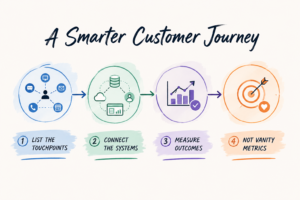
Every customer transaction tells a story, but focusing only on the first purchase misses the bigger picture. To drive sustainable growth, businesses must look beyond immediate sales. This is where Customer Lifetime Value (CLV) comes in.
But what exactly is CLV, and why has it become the ultimate metric for modern marketing and financial forecasting? In this guide, we will explore how to calculate this critical metric, optimize marketing spend, and use unified data to drive long-term profitability. Let’s dive in.
What Does Customer Lifetime Value Mean?
Customer Lifetime Value (CLV), also known as LTV or CLTV, estimates the total revenue or profit a customer generates throughout their relationship with your business. Instead of focusing on isolated transactions, CLV tracks long-term customer behavior.
This metric helps businesses evaluate segment profitability, refine marketing strategies, and optimize financial planning by measuring the true economic value of acquiring and retaining customers.
A strong CLV analysis should account for:
- Average purchase value
- Purchase frequency
- Customer lifespan
- Customer retention and churn
- Gross margin or contribution margin
- Customer acquisition cost
- Ongoing service and retention costs
Revenue-based CLV provides a useful starting point, but profit-based CLV gives decision-makers a more realistic view of customer profitability.
Ready to reveal your true customer value? Let Mackdata handle the heavy lifting
Improve Your Understanding of Client Behavior With Mackdata
How to Calculate Customer Lifetime Value
There is no single formula that works perfectly for every business model. A retailer may focus on average order value and purchase frequency, while a subscription business may rely on recurring revenue and churn rate. A home service company may need to include repeat jobs, maintenance plans, call data, and service costs.
The Customer Lifetime Value Formula
A widely used customer lifetime value formula is:
Customer lifetime value = Average purchase value × Average purchase frequency × Average customer lifespan
Businesses can calculate the three inputs using the following process:
- Divide total revenue by the number of purchases to calculate average purchase value.
- Divide the total number of purchases by the number of unique customers to calculate purchase frequency.
- Calculate the average length of time customers continue buying from the business.
- Multiply customer value by the average customer lifespan.
- Apply gross margin and subtract acquisition or service costs for a profit-based result.
The simple CLV formula is accessible, but it relies heavily on historical data. It assumes future customer behavior will resemble past purchase patterns, which may not hold true when pricing, demand, retention rates, or market conditions change.
For a more financially accurate calculation, businesses can use:
CLV = (Average purchase value × Purchase frequency × Customer lifespan × Gross margin) − Acquisition and service costs
This version distinguishes between total revenue and actual customer profitability.
A Customer Lifetime Value Calculation Example
Consider a company with an average purchase value of $300. Its average customer makes three purchases per year and remains active for four years.
The revenue-based calculation would be:
$300 × 3 × 4 = $3,600
The average customer lifetime value is therefore $3,600 in revenue.
Suppose the company has a 40% gross margin and spends an average of $250 to acquire each new customer. A simplified profit-based calculation would be:
($3,600 × 40%) − $250 = $1,190
The example also shows why businesses should avoid evaluating marketing performance solely through immediate conversion revenue. A campaign that generates fewer first-time purchases may still create more value if it attracts loyal customers who buy repeatedly over time.
Turn Customer Data Into More Accurate CLV Insights
Basic spreadsheets can calculate average customer lifetime value, but reliable analysis requires complete customer records. A business must connect purchase history, lead sources, CRM activity, calls, marketing campaigns, and revenue outcomes to understand the full relationship.
An AI-powered marketing intelligence platform, like Mackdata, can unify these records and help teams analyse CLV by channel, campaign, service, location, or customer segment. This is particularly important when one person interacts through multiple devices, phone numbers, email addresses, or sales channels.
Disconnected systems can create several errors:
- Repeat customers may be counted as new customers.
- Offline purchases may not be connected to digital campaigns.
- Calls may be excluded from the customer journey.
- Service costs may not be included in profitability.
- Assisted marketing touchpoints may receive no credit.
- Revenue may be attributed only to the final interaction.
Accurate CLV depends on integrated business data, not just a formula. When customer identities and transactions are unified, decision-makers gain a clearer view of which relationships, campaigns, and channels produce long-term revenue.
Don’t get stuck in spreadsheets. Automate complex data effortlessly using Mackdata today
How Customer Lifetime Value Supports Better Business Decisions
CLV connects customer behavior to financial outcomes, helping businesses determine sustainable acquisition budgets, prioritize retention investments, and identify future growth opportunities. By looking beyond isolated conversions, industries from retail to home services can make strategic, long-term decisions that optimize overall profitability rather than short-term transaction volume.
Compare Customer Acquisition Cost With the LTV-to-CAC Ratio
Customer Acquisition Cost (CAC) measures what you spend to win a new customer. The LTV-to-CAC ratio compares a customer’s lifetime value to that acquisition cost:
LTV-to-CAC ratio = Customer lifetime value ÷ Customer acquisition cost
While a 3:1 ratio is a healthy industry benchmark, context is everything. A 1:1 ratio means you are spending too much to acquire customers, risking insolvency. Conversely, a 5:1 ratio might suggest you are under-investing and leaving growth on the table. Breaking this ratio down by marketing channel and customer segment prevents blended averages from hiding unprofitable campaigns or highly valuable customer cohorts.
Segment High-Value Customers by Channel, Campaign and Behavior
Average CLV can provide a useful benchmark, but it can also conceal meaningful differences between customer groups. Customer segmentation allows businesses to identify which audiences, locations, campaigns, and behaviors are associated with higher lifetime value.
Useful CLV segments may include:
- Acquisition channel or lead source
- Marketing campaign
- Geographic location or territory
- First product or service purchased
- Customer cohort or acquisition month
- Purchase frequency
- Service category
- Profitability or gross margin
- Retention risk
Segment-level analysis helps marketing teams move beyond total lead volume and assess the long-term quality of each acquisition source.
Connect Marketing Spend to Long-Term Customer Revenue
Traditional reporting stops at initial clicks or conversions. Connecting marketing spend to customer-level revenue enables closed-loop attribution, letting you evaluate acquisition channels by the total value they generate over time. This prevents businesses from cutting seemingly expensive channels that actually produce highly profitable, loyal customers.
Cross-channel campaign measurement should therefore include:
- Initial conversion value
- Repeat purchases
- Customer retention
- Revenue generated over time
- Gross margin
- Acquisition and service costs
- Assisted marketing touchpoints
Connect campaign performance to customer lifetime revenue before deciding where the next marketing dollar should go
How to Improve Customer Lifetime Value
Improving customer lifetime value requires more than encouraging another purchase. Businesses must strengthen retention, increase purchase frequency, raise average order value, and improve the customer experience. The most effective strategies combine relevant communication, stronger service, intelligent segmentation, and connected data across every stage of the relationship.
- Improve customer retention: Identify why customers leave, address service problems quickly, reward loyalty, and create consistent experiences that give existing customers stronger reasons to continue buying from the business.
- Increase purchase frequency: Use timely reminders, personalized recommendations, replenishment messages, and relevant follow-up campaigns that encourage customers to return sooner without overwhelming them with repetitive or poorly targeted promotions.
- Raise average order value: Introduce thoughtful bundles, cross-selling, upselling, premium options, and complementary services that improve each purchase rather than pushing customers toward products or services they do not need.
- Use customer segmentation: Tailor messaging, offers, and retention strategies around purchase history, channel, location, behavior, and profitability, giving each customer group a more relevant and valuable experience over time.
- Connect customer and marketing data: Unite CRM, transaction, marketing, and service records so teams can identify high-value customers, measure channel-level CLV, recognise retention risks, and make better acquisition decisions.
The right strategy depends on what is limiting customer value. A business with high churn needs a different approach from one with strong retention but low purchase frequency. CLV should therefore be monitored alongside customer satisfaction, average order value, gross margin, churn rate, and acquisition cost.
Boost retention and lifetime revenue. Drive smarter customer growth strategies with Mackdata
Connect Customer Lifetime Value to Revenue With Mackdata
Customer lifetime value becomes more useful when businesses can trace revenue back to the campaigns, calls, channels, and customer interactions that created it. At Mackdata, we connect data from CRM, POS, call-tracking, marketing, and analytics systems to provide closed-loop visibility from initial touchpoint to long-term revenue.
Instead of manually combining dashboards and spreadsheets, teams can ask Mack questions in natural language and receive answers grounded in their connected business data. This allows decision-makers to compare customer value by channel, identify profitable segments, understand repeat revenue, and improve marketing budget allocation.
Mackdata is built for operators and marketing leaders who need more than a high-level average. Our identity graph and attribution capabilities help unify customer records, connect marketing spend to revenue, and reveal the actions most likely to drive profitable growth.